Under the noise of wars and endless strife, beneath the headlines of natural disasters and diseases, there flows a hidden current—a silent river, dark with sorrow. This river, as ancient as the stars, carries the weight of Won(寃) and Han(恨): twin forces of grievance and deep-seated pain that echo through individuals, peoples, and even the cosmos.
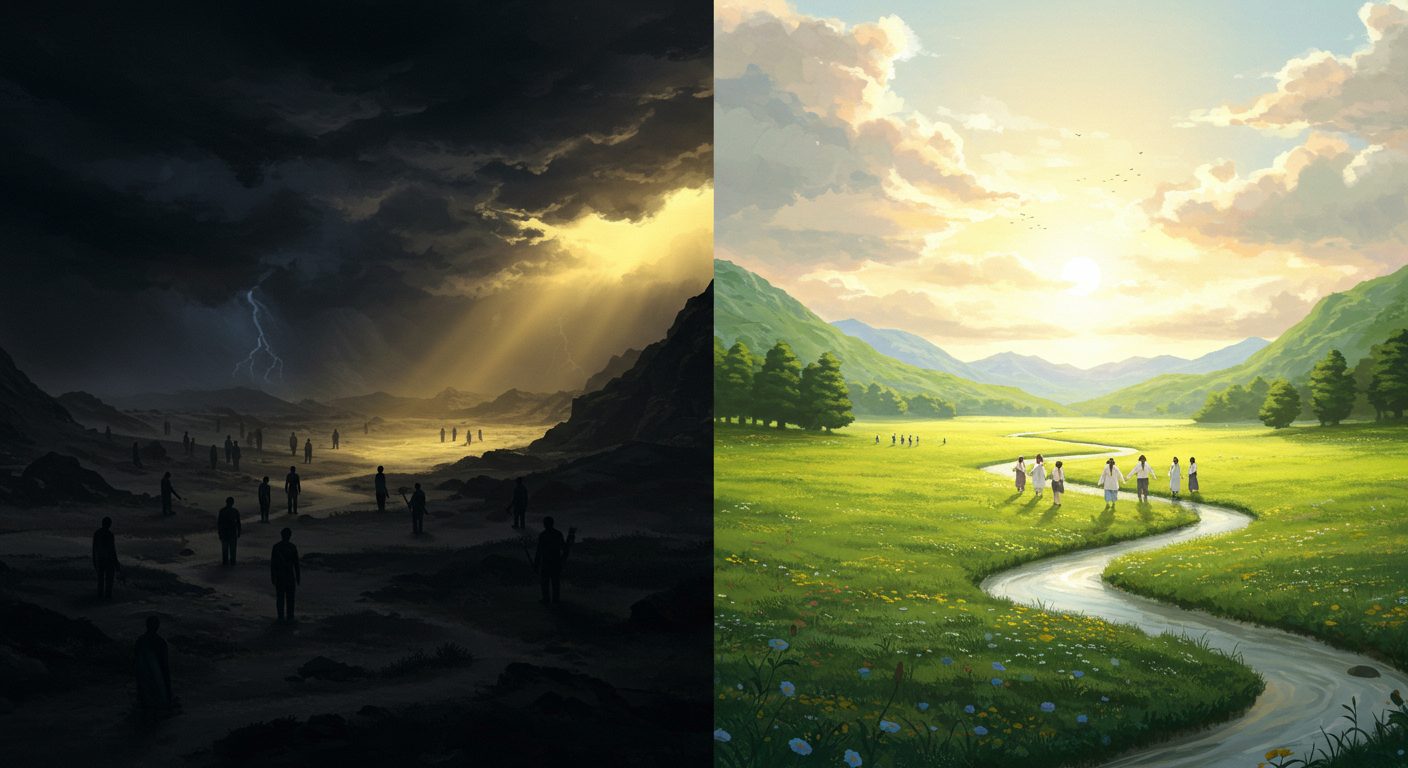
We see it everywhere—conflicts that never truly end, suffering that passes down through generations. Think of the ongoing tensions between India and Pakistan, or the countless fault lines of hurt across the globe. Historians and diplomats point to borders, treaties, and political failures. They're not wrong. But what if something deeper is at work? What if the world’s unrest isn’t just political—but spiritual?
The teachings of Jeung San Do, a Korean spiritual organization that teaches the cosmic principles of balance and healing, describe Won(寃) and Han(恨) not as fleeting emotions but as elemental cries of the soul—wounds left unhealed, wrongs left unresolved.
- Won is the pain of being blocked, oppressed, or unheard. It’s like a rabbit trembling in a snare—trapped by forces it cannot escape.
- Han runs deeper: a smoldering resentment, a silent scar etched into the heart.
Together, they form Wonhan(寃恨)—not just private grief, but a collective, often generational storm. When left unresolved, Wonhan hardens seeking revenge, and in its final state, it becomes Salgi(殺氣): destructive energies that erupt as violence, collapse, and even natural disaster. Have you ever witnessed a conflict that seems too bitter, too stubborn to be explained by politics alone? That may be Wonhan at work.
According to Jeung San Do, Wonhan is more than psychological trauma—it is cosmic in scope. It has afflicted the universe since the era of the Early Heaven (Seoncheon), a time when the principle of Sanggeuk(相克)—mutual restraint—reigned supreme.
Under Sanggeuk, even heaven and earth were at odds. Every competition, war, betrayal, and unspoken hurt added to the weight of Wonhan until the cosmic principle changed into Sangsaeng(相生), mutual life-giving. According to the Dojeon, the sacred scripture of Jeung San Do, Sangjenim, the Sovereign of all life, declared: If all the bitterness and grief born of sanggeuk were allowed to explode, the universe itself would collapse into ruin. (Dojeon 2:14:5)
No philosophy, no ideology of the past could fully heal this destructive energy. Because Wonhan is not bound by nation, race, or century—it is the burning fever of a wounded cosmos.
Let’s return to our world. From the smoldering border between India and Pakistan to the war-torn cities of Ukraine and Russia, and the escalating tensions between Israel and Iran, we see the same patterns unfold—bitter disputes that refuse to die, fueled not just by politics, but by unresolved spiritual wounds.
Take, for example, the lingering pain between India and Pakistan. It is more than geopolitics—it is a parable of Wonhan. From the 1947 Partition to Kashmir’s enduring grief, from the 1970 cyclone in East Pakistan to the brutal “Searchlight Operation” of 1971, each chapter is steeped in betrayal, loss, and unresolved anguish.
We can map the events. But beneath them flows a spiritual current—millions weeping for lost homes, shattered lives, and dreams torn from history. From Jeung San Do's perspective, these aren’t just tragedies. They are spiritual ruptures—tensions that form knots of energy in the fabric of time. These aren’t sparks of conflict; they are flares of unresolved Wonhan.
This perspective doesn’t reject political analysis. Treaties, borders, and resources matter. But they only tell us how conflicts unfold. Wonhan reveals why. The world is sick not only because of greed or error but because its soul is deeply wounded.
Disease, disaster, division—these are symptoms of accumulated karmic pain, fed by unresolved resentment among human beings and spiritual entities. The earth is crying, not just burning.
But there is hope. Sangjenim as the cosmic healer, undertook the great Cheonji Gongsa—a divine work of renewing Heaven and Earth. Central to this is a transformation: from Sanggeuk’s division to Sangsaeng's unification based on the principle of mutual life-giving.
The key is Haewon(解寃)—the act of resolving bitterness and grief, of releasing the knots of Wonhan. True peace begins not with paperwork, but with inner release, both individual and collective.
The turmoil we see—wars, climate shifts, social fractures—may be the symptom of Gaebyeok, the great cosmic shift for renewal, rising like a tidal wave. This is not the end—it is labor pain. The old systems are breaking down to give birth to something new: a world of Sangsaeng, where life nurtures life, and the river of Wonhan is finally allowed to rest.
The healing of the cosmos is not only the task of heaven—it is ours, too.
We can begin by:
- Listening to the pain beneath conflict
- Practicing compassion where bitterness lingers
- Seeking reconciliation—personal, national, and global
- Understanding that healing is not weakness, but wisdom
As we stand at the threshold of this transformation, let us become part of the sacred labor—the work of Haewon. This is how true healing begins—by releasing the past, restoring what was broken, and awakening genuine Sangsaeng, the spirit of mutual life-giving. In the end, this is not just a choice, but the only path to true and lasting peace.